From audit to pre-flight: forecast, coverage, assessment, readiness, and an assistant
June 12, 2026
We measured Bifrost against GitHub’s documented golden path for Azure DevOps to GitHub
Actions migration — configure → audit → forecast → dry-run → migrate, and the wider
Plan, Assess, Test, Migrate, Validate, Decommission program. Bifrost was already ahead on
conversion quality and governance: review-first, grounded generation, a deterministic risk
model, per-project reporting, and PR-only delivery. The gaps were on the bookends — the
forecast (what GitHub will cost and need) and the program scaffolding a migration manager
needs before changing anything.
This round closes those gaps. Every new surface follows the same rule the risk model does: the model explains; it does not score, and it does not price. Cost, coverage, and readiness are computed deterministically from the audit — never by an LLM.
Forecast — what GitHub will cost and need
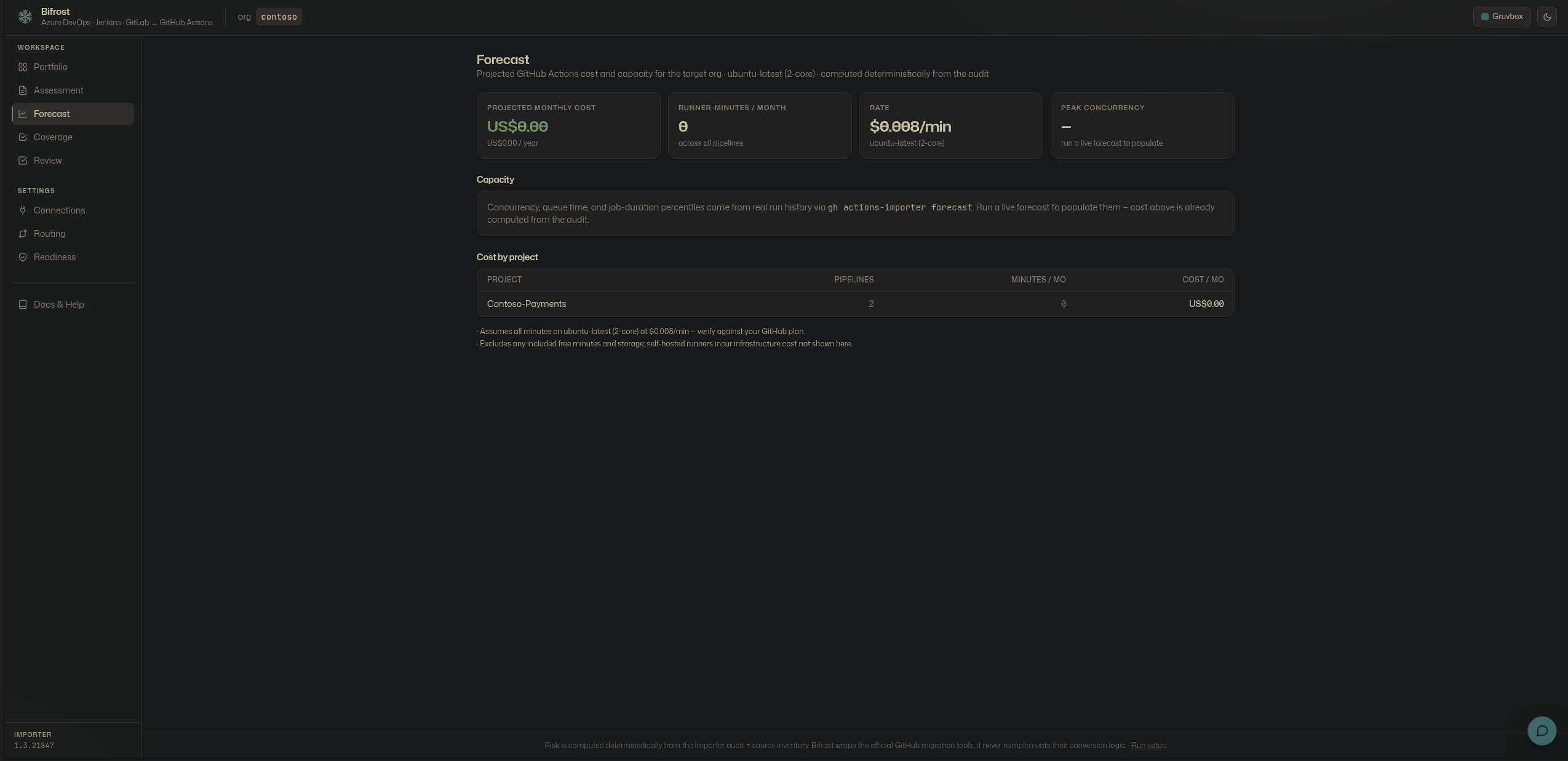
The golden path runs gh actions-importer forecast to project Actions usage before migrating.
Bifrost makes that projection deterministic: monthly and annual cost, runner-minutes, and a
per-project breakdown, computed from the audit’s per-pipeline minutes against a configurable,
cited runner-rate table. Capacity figures that need real run history — peak concurrency, queue
time, duration percentiles — are carried from the Importer forecast, never fabricated.
Coverage — find every moving part, leave nothing behind
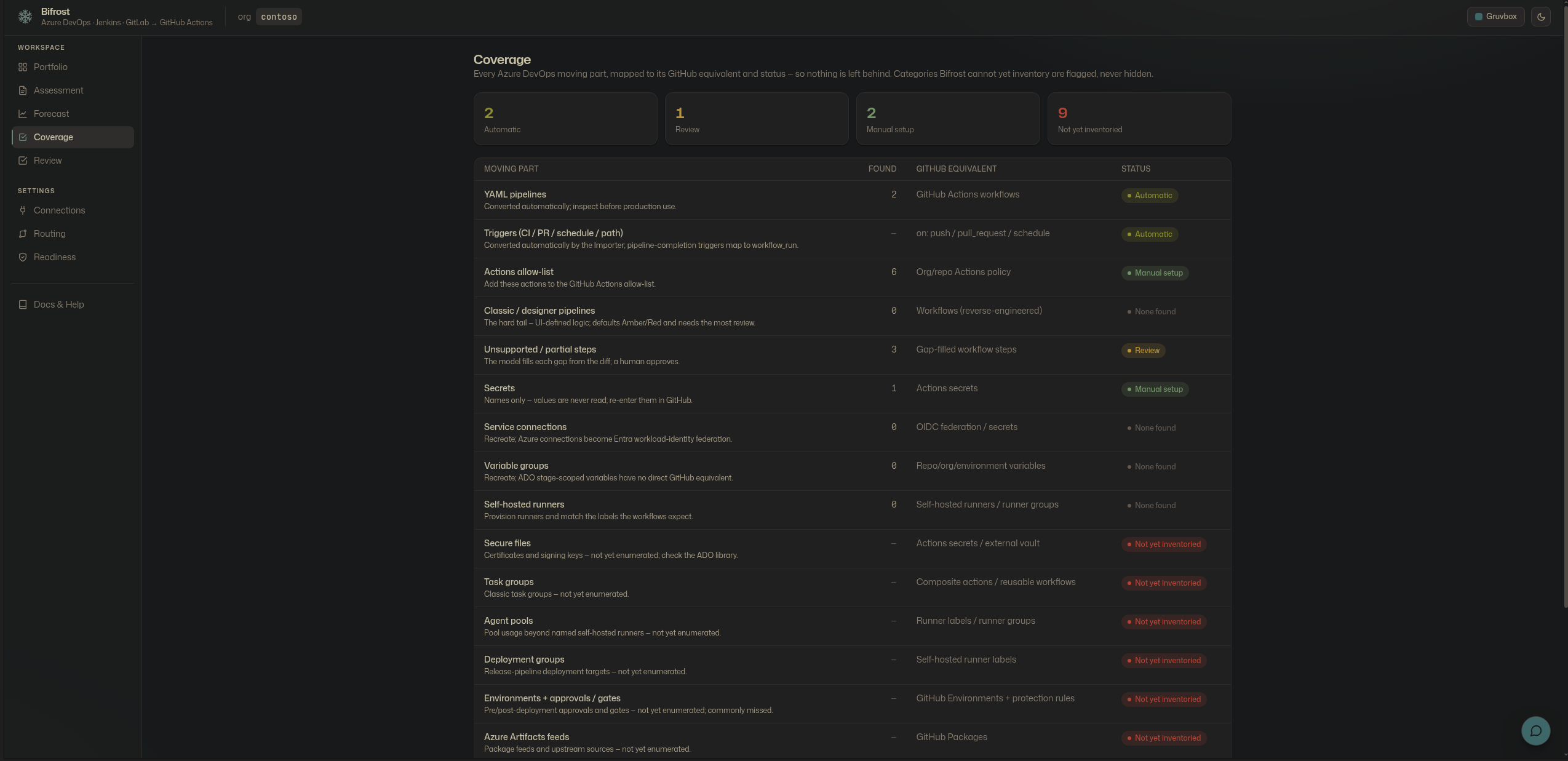
“How do we make sure everything migrates?” is answered by a completeness matrix: every Azure DevOps moving part mapped to its GitHub equivalent and a status — automatic, review, manual setup, or not yet inventoried. That last status is the point: categories Bifrost cannot yet enumerate (secure files, task groups, agent pools, environments and gates, artifact feeds) are flagged in red rather than quietly omitted, so nothing is dropped without a trace.
Assessment — status of the source, before any change
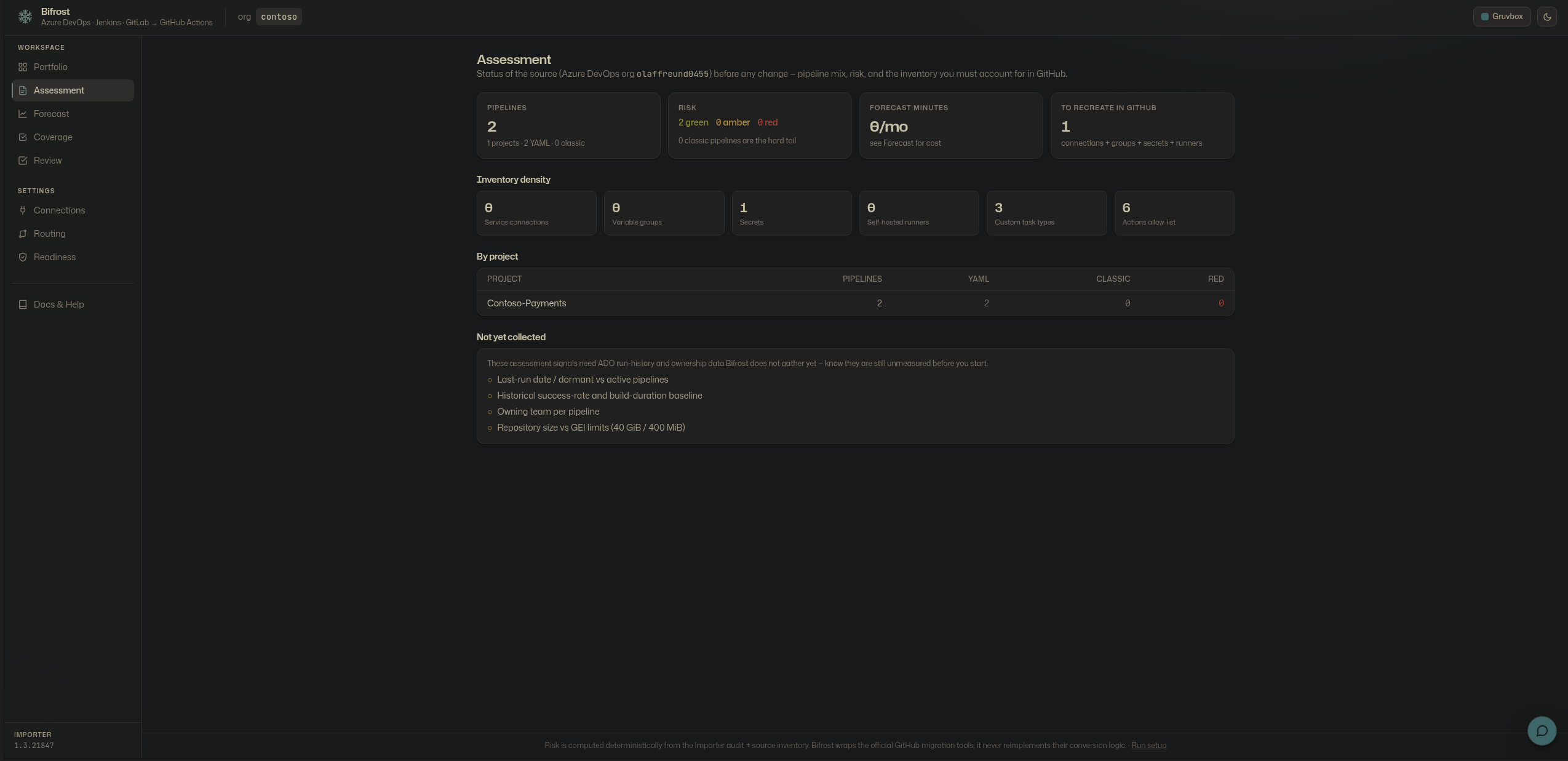
The source side gets its own assessment: pipeline mix (YAML vs the classic designer tail), risk distribution, and the inventory density a program must account for — service connections, variable groups, secrets, self-hosted runners, custom task types, the Actions allow-list — with a per-project breakdown. Signals Bifrost does not yet collect (dormancy, success-rate baseline, owning team, repository size for GEI) are listed honestly so a team knows what is still unmeasured.
Readiness — is GitHub ready to receive it
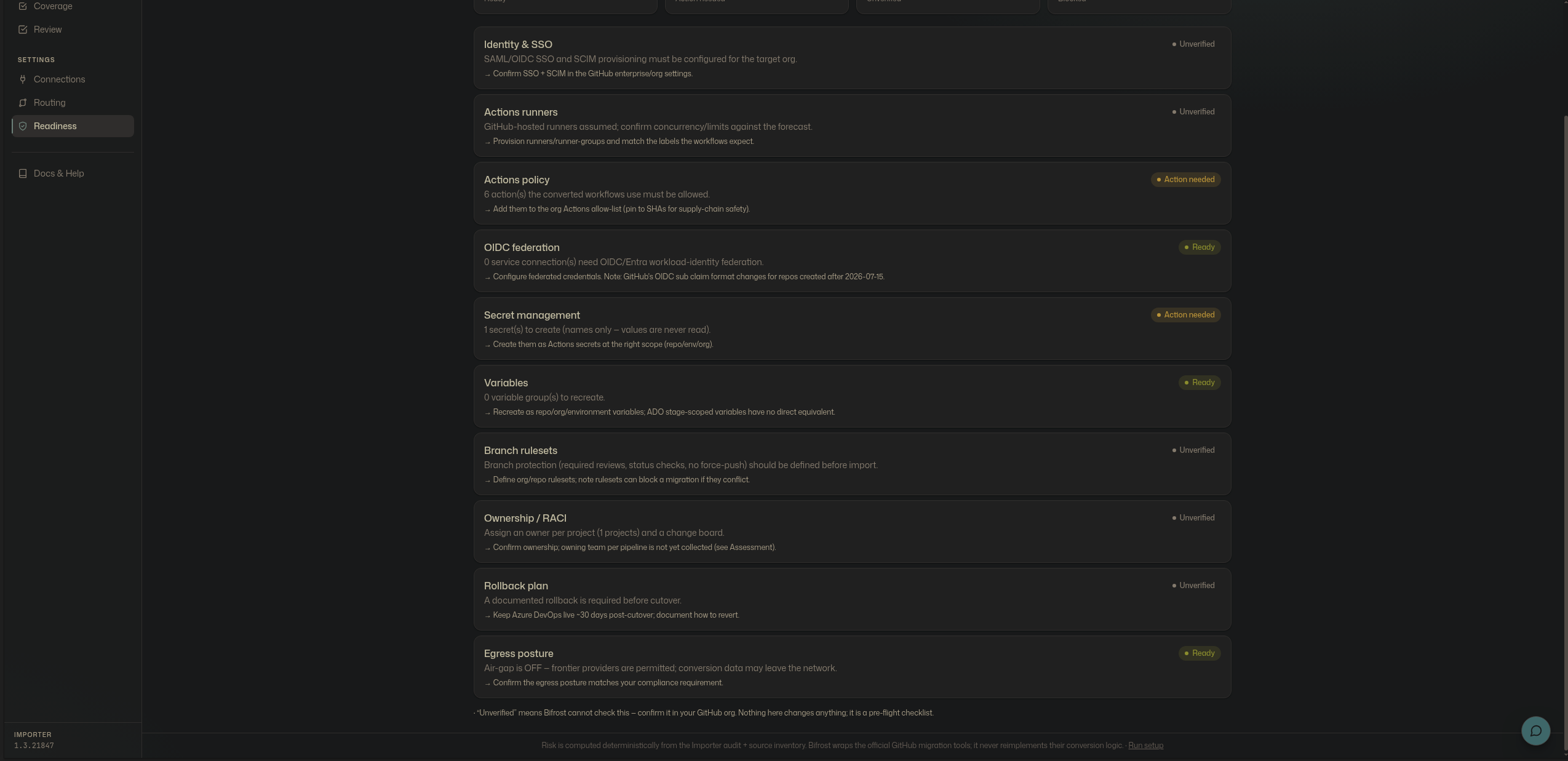
The pre-flight partner to the assessment. A checklist of what must be true in the target org: runners sized to the forecast, the Actions allow-list, OIDC/Entra federation for service connections (it even flags GitHub’s 2026 change to the OIDC subject claim), secret management, branch rulesets, ownership, and a rollback plan. Items Bifrost can quantify from the audit carry a count and an action; operational gates it cannot verify are marked unverified rather than a false green.
An assistant that knows your migration
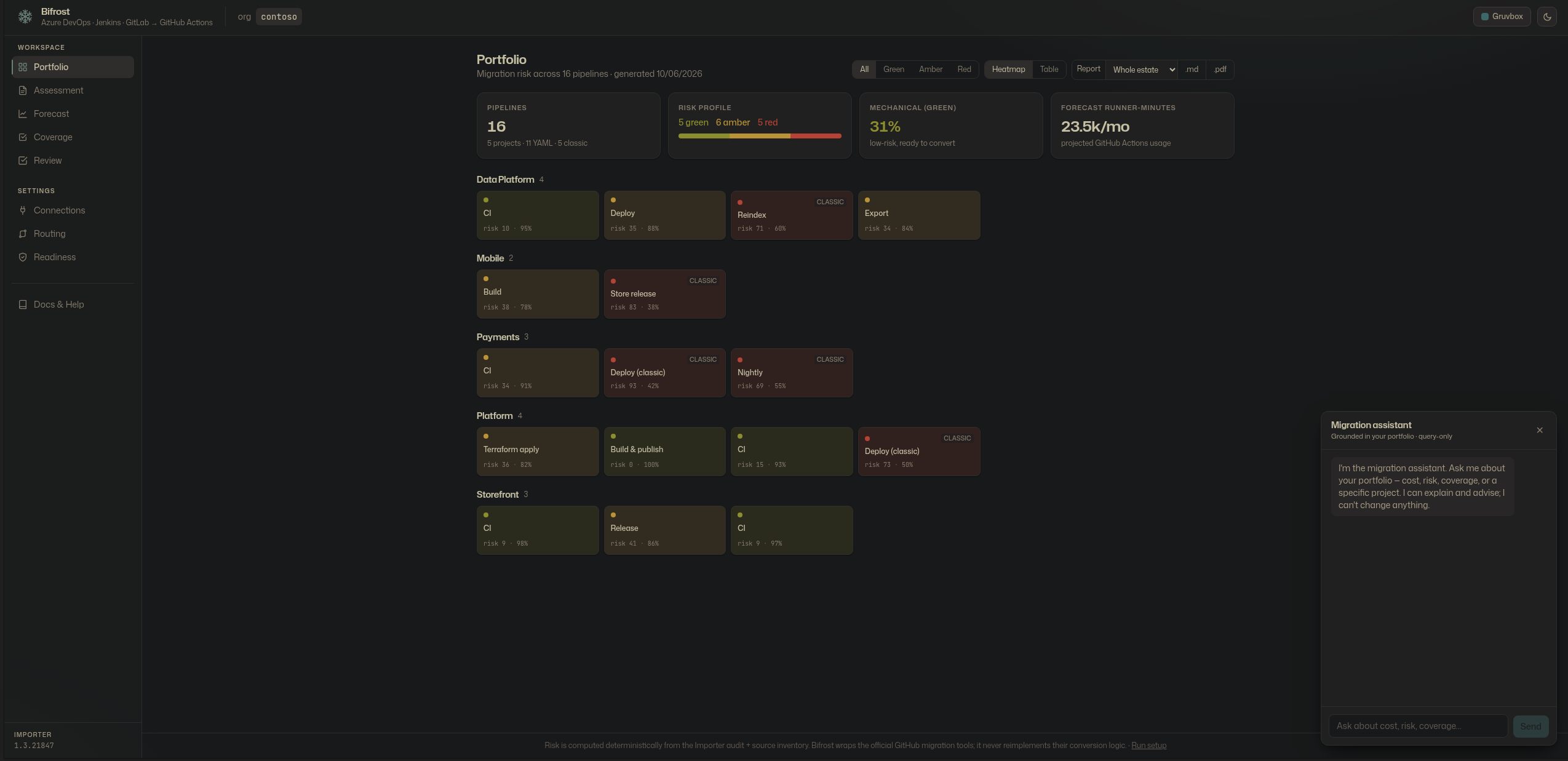
A popout assistant answers questions about the migration — cost, risk, coverage, a specific project — grounded in the same deterministic state. It is routed through whatever LLM is configured, so air-gap mode forces it local and no pipeline data leaves the box. It is query-only by design: it explains and advises, but it cannot change anything. Control actions stay behind the existing human-approval and audit-logged path.
Routing and air-gap, unchanged in spirit
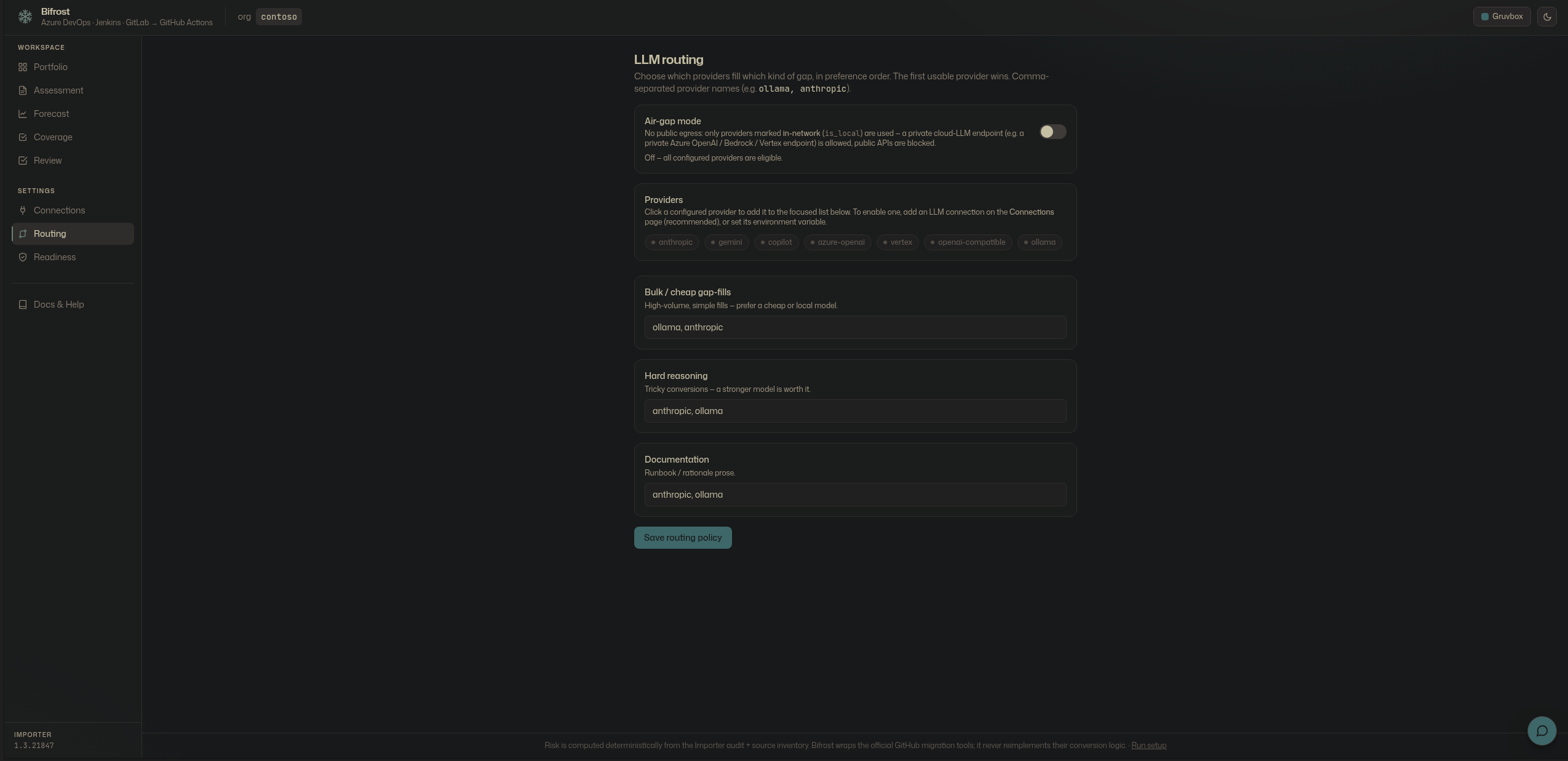
All of it respects the routing policy: bulk and cheap work to a local or small model, hard reasoning to a frontier model, and in air-gap mode everything is forced local.
With these, the picture before a migration is complete: Assessment (what’s in Azure DevOps), Forecast (what GitHub will cost), Coverage (what migrates and what’s left), and Readiness (whether GitHub is ready) — and an assistant to ask about any of it. All of it review-first, grounded, deterministic where it must be, and attestable. See the full golden-path alignment for how this maps to GitHub’s documented process.
Screenshots show Bifrost across its Gruvbox themes, against both the synthetic
contoso sample and a small live Azure DevOps audit. No secrets are shown — Bifrost
records secret names and types only, never values.